You’ve likely heard that the Federal estate tax exemption amount is jumping to $15 million in 2026; for married couples that will be $30 million! Well over an average family’s gross estate. However, those of us in New York still have to consider the significantly lower New Your State estate tax exemption amount, and the fact that in New York, unlike federally, for estates over the exemption amount the amount does not double without proactive estate tax planning.
As of January 1, 2025, the New York State estate tax exemption is $7,160,000.
This means that if a person’s estate is valued at less than $7,160,000 at the time of their death in 2025, it will not be subject to New York State estate tax.
However, New York State has a “cliff” provision for estate taxes: if the value of the estate exceeds the exemption amount by more than 5%, the entire estate (not just the amount over the exemption) becomes subject to the estate tax. The New York estate tax rate is graduated, ranging from 3.06% to 16% depending on the estate’s value.
For example, an estate worth between $7,160,000 and $7,518,000 (105% of the exemption) would pay tax only on the portion exceeding $7,160,000. If an estate exceeds $7,518,000, the entire value of the estate is subject to the estate tax.
New York Estate Tax for Married Couples
When someone dies, money that goes to their spouse is not subject to the estate tax in New York or at the federal level. When the second spouse dies, any amount of the estate exceeding $7.16 million will be subject to normal New York estate tax rules, i.e. the New York estate tax exemption is not portable between spouses, unlike the federal estate tax exemption. This means that the exemption amount does not automatically double for married couples. If your estate is over $7,160,000, you must add estate tax planning to your estate plan documents or there will be estate taxes due at the death of the surviving spouse.
How couples who do estate planning get around this, is by establishing a trust equal to the estate tax exemption and exposing it to the estate tax upon the first spouse’s death, meaning that money won’t be taxed when the second spouse dies. If your estate is over $7,160,000 you should seek the advice of an estate planning attorney to help you “double your bucket”.
New York Estate Tax for Unmarried People
Unfortunately, we cannot double the exemption amount for unmarried people. However, depending on the size of the estate there are several strategies which can be used to reduce the chances of estate tax, or at least minimize them. If your estate is over $7,160,000 you should seek the advice of an estate planning attorney to help you minimize the impact estate taxes may have on your New York estate.
Why is this a big deal?
The estate tax rate for New York is graduated. It starts at 3.06% and goes up to 16%. The taxable estate is the value of the estate above the $7.16 million exemption. However, New York is a “cliff” state, This means that if the estate reaches the cliff of 105% of $7.16 million, then the whole estate is taxable! Here’s how to figure out what you’ll be paying: First, figure out what your taxable estate is. If your total estate is worth less than $7,518,000, the taxable estate is the total amount minus $7.16 million.
Next, find your taxable estate bracket in the chart below. The base taxes amount in the second column is what you owe on money that falls below your tax bracket. Then figure out by how much your estate exceeds the lower limit of your bracket and multiply that number by the marginal rate. Add that number to your base and you should know what you owe.
Here’s an example: Let’s say your total estate is worth $8 million. That exceeds the $7,518,000 cliff, so all of it is taxable. Next, we find where that number falls on the chart. The base tax for the bracket is $650,800. The bottom of the threshold is $7.1 million, so we subtract that from $8 million and get $900,000. That amount multiplied by the marginal rate of 13.6% is $122,400. When we add that number to the base tax, we get a total tax of $773,200 on an $8 million estate.
New York Estate Tax Rates
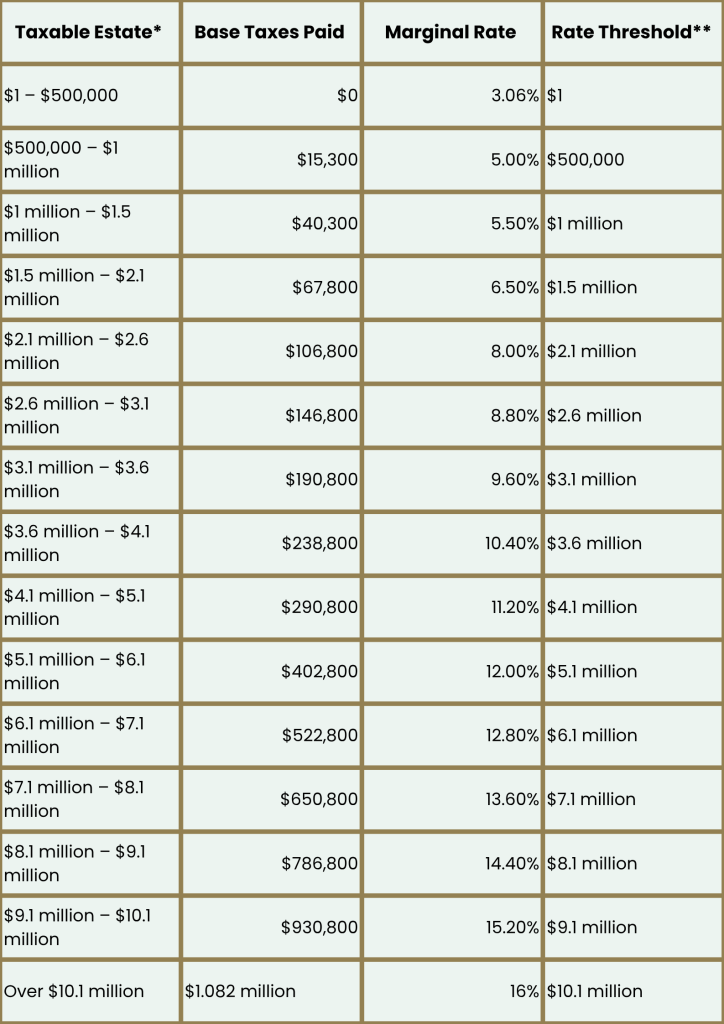
*The taxable estate is the amount above the 2025 exemption of $7.16 million.
**The rate threshold is the point at which the marginal estate tax rate goes into effect.
Why plan?
With proactive estate tax planning, instead of your family paying $773,200 on an $8 million estate, they could pay nothing! That is $773,200 reasons why planning pays for itself.
New York Gift Tax
The federal gift tax exemption is $19,000 per recipient for 2025, up from $18,000 in 2024. Any gift to a single person in one year that exceeds that amount will count against your 2025 lifetime exemption of $13.99 million and $15 million lifetime exemption after 2026.
However, New York does not currently have a gift tax, meaning that if someone wants to avoid their estate having to pay high taxes, they can give away money as gifts before they die. One important caveat, though: gifts made within three years before the person dies are counted toward establishing a person’s estate total, so you can’t give all your money to someone on your deathbed to avoid paying taxes.
Gifting is a great strategy to reduce your potential estate tax liability if you are over the 2025 exemption of $7.16 million when it is done properly. If your estate is over $7,160,000 you should seek the advice of an estate planning attorney to help you create a gifting plan that can minimize the impact estate taxes may have on your New York estate.
2026 and Beyond
Under the Big Beautiful Bill we now know that the Federal estate tax exemption amount is jumping to $15 million in 2026. But what will happen in New York is unclear. It is highly unlikely that New York will increase its exemption to $15 million. Currently, the lifetime gift and estate tax exemption is projected to be $7 million in 2026. We have to stay tuned for further guidance.
If your estate is over $7,160,000 give our office a call to set up a Life & Legacy Planning Session where we will dive deep into your specific situation and to help you create a plan that can minimize the impact estate taxes will have on your New York estate.